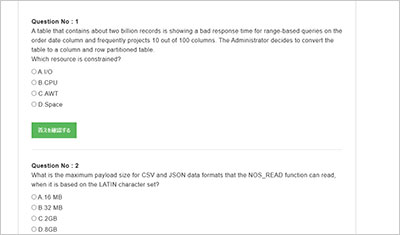
サンプル問題 1: There is a call center application that repetitively sends tactical queries to Vantage These queries use a few small tables that are joined on the primary index column. The following maps are defined in the system: * TD_GlobalMap * TD_Map1 * TD_DataDictionaryMap * TD_1AmpSparseMap_1Node What can be done to optimize these queries?
A: Assign these tables to TD_1AmpSparseMap_1Node using different colocation names for each table.
B: Assign these tables to TD_1AmpSparseMap_1Node using the same colocation name for every table
C: Assign these tables to TD_Map1 using the same colocation name for every table.
D: Assign these tables to TD_Map1 using different colocation names for each table.
正解:B
Explanation: Example: TD_1AmpSparseMap_1Node is a sparse map that assigns the data to a single AMP (or a few AMPs), and using the same colocation name ensures that the tables are collocated on the same AMP. This helps in efficient joining because no data redistribution is required between AMPs when tables are joined on the primary index. Using different colocation names for each table (options A and D) would place the tables on different AMPs, leading to less efficient joins since data would need to be shuffled between AMPs. TD_Map1 is a predefined map in the system but does not specifically optimize small, frequently accessed tables in the same way that TD_1AmpSparseMap_1Node does, which is more suitable for these scenarios. Thus, using the same colocation name within the TD_1AmpSparseMap_1Node ensures that the joins are AMP-local, optimizing the repetitive tactical queries
サンプル問題 2: What is a use case for Data Mover?
A: Archiving data to a Hadoop system
B: Copying data between Vantage systems for active-active replication
C: Replicating data to a disaster recovery system
D: Copying data between Hadoop systems
正解:C
Explanation: Teradata Data Mover is primarily designed to copy and replicate data between Teradata or Vantage systems. One of its common use cases is to move data to a disaster recovery system, ensuring that data is available in case of system failure or disaster, and making it a valuable tool for maintaining high availability and business continuity. Archiving data to Hadoop and Copying data between Hadoop systems are more relevant to other tools such as Teradata QueryGrid, which integrates Vantage with Hadoop and other external systems. Copying data between Vantage systems for active-active replication might involve Data Mover, but active-active replication typically involves more sophisticated real-time synchronization technologies like Teradata's Unity or QueryGrid.
サンプル問題 3: An Administrator manages a Vantage system that is continually updated. The system is critical to the business and must be available as much as possible. The Administrator decides to use a backup strategy that will allow changes to tables while a backup is in progress. Which backup strategy should be used?
A: Offline
B: Skip statistics
C: Online
D: Dictionary Only
正解:C
Explanation: An Online backup strategy allows the database to remain accessible and operational while the backup is taking place. This means that users can continue to modify data, and the system can remain available without requiring downtime. It is a common approach for mission-critical systems that need to maximize uptime. Offline would require the system or certain tables to be unavailable during the backup process, which is not suitable for a system that needs to remain available. Skip statistics refers to skipping the backup of statistics on database objects and does not relate to whether the system can be updated during the backup. Dictionary Only involves backing up only the system catalog or dictionary data, not the actual table data, and would not fulfill the requirement of a comprehensive backup while allowing updates.