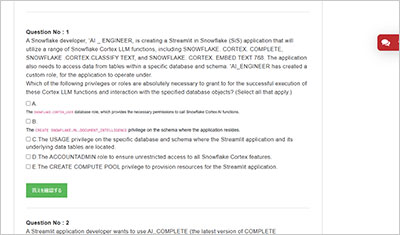
サンプル問題 1: A data architect is integrating Snowflake Cortex LLM functions into various data enrichment pipelines. To ensure optimal performance, cost-efficiency, and accuracy, which of the following are valid best practices or considerations for these pipelines?
A: When extracting specific entities from documents using SAI EXTRACT or '!PREDICT, it is often more effective to fine-tune a Document AI model for complex or varied document layouts rather than relying solely on extensive prompt engineering for zero-shot extraction.
B: For tasks requiring deterministic JSON outputs, explicitly specifying a JSON schema using the ‘response_format' argument with 'AI COMPLETE is crucial, and for OpenAI (GPT) models, including the ‘required' field and setting ‘additionalPropertieS to 'false' in every node of the schema is a mandatory requirement.
C: To manage costs effectively for LLM functions like SAI COMPLETE in a pipeline, always use the largest available warehouse size (e.g., 6XL Snowpark- optimized) to maximize throughput, as this directly reduces the overall token processing time and cost.
D: When performing sentiment analysis on customer feedback using 'AI_SENTIMENT, it's best practice to pass detailed, multi-turn conversation history to the function to enhance accuracy, similar to how 'AI_COMPLETE handles conversational context.
E: For data enrichment involving classification with 'AI_CLASSIFY', using descriptive and mutually exclusive categories in plain English, along with an optional clear task description, can significantly improve classification accuracy.
正解:A, B, E
Explanation: Option A is correct. For extracting information from documents with complex or varied layouts, fine-tuning a Document AI model can significantly improve results compared to relying solely on zero-shot extraction and extensive prompt engineering. Document AI provides both zero-shot extraction and fine-tuning capabilities, with fine-tuning recommended to improve results on specific document types. Option B is correct. To ensure 'AI_COMPLETE (or 'COMPLETE) returns responses in a structured JSON format, it is essential to specify a JSON schema using the ‘response_format’ argument. For OpenAl (GPT) models, specific requirements include setting ‘additionalPropertieS to 'false' in every node and ensuring the ‘required' field lists all property names. Option C is incorrect. Snowflake explicitly recommends executing queries that call Cortex AISQL functions (such as 'AI COMPLETES) using a smaller warehouse, no larger than MEDIUM. Using larger warehouses does not increase performance for these functions but will incur unnecessary compute costs. The LLM inference itself is managed by Snowflake, and its performance isn't directly scaled by warehouse size in the same way as traditional SQL queries. Option D is incorrect. 'AI_SENTIMENT (and 'SENTIMENT) is a task-specific function designed to return a sentiment score for a given English-language text. Unlike 'AI_COMPLETE (or 'COMPLETE'), which supports multi-turn conversations by passing conversation history for a stateful experience, SAI SENTIMENT processes individual text inputs and is not designed to leverage multi-turn context in the same way for sentiment analysis. Option E is correct. For classification tasks using 'AI_CLASSIFY (or 'CLASSIFY TEXT), best practices include using plain English for the input text and categories, ensuring categories are descriptive and mutually exclusive, and adding a clear ‘task_description’ when the relationship between input and categories is ambiguous. These guidelines significantly improve classification accuracy.
サンプル問題 2: An ML engineering team is preparing to log a custom Python model to the Snowflake Model Registry. This model has several Python package dependencies. The team wants to ensure the model can be deployed optimally, either in a Snowflake warehouse or to Snowpark Container Services (SPCS), depending on future needs. They are particularly concerned with how dependency specification impacts deployment eligibility. Which statements accurately describe how Snowflake handles model dependencies and determines deployment eligibility for custom Python models logged in the Model Registry, particularly when considering both Snowflake warehouse and Snowpark Container Services (SPCS) environments? (Select all that apply.)
A: If all of a model's ‘conda_dependencieS are available in the Snowflake conda channel, the model is automatically deemed eligible to run in a warehouse.
B: For models intended for SPCS, ‘pip_requirements’ are always preferred over ‘conda_dependencies’ because SPCS strictly prohibits the use of any conda packages from ‘conda-forge’
C: When ‘conda_dependencies’ are specified for a model to be deployed to SPCS, these dependencies are by default obtained from ‘conda-forge’ rather than the Snowflake conda channel.
D: The function will fail if 'WAREHOUSE is specified in ‘target_platforms’ but the model's size or GPU requirements make it ineligible for warehouse deployment.
E: Specifying both ‘conda_dependencies’ and ‘pip_requirements’ for a model is recommended to cover all possible deployment scenarios, and Snowflake's build process ensures compatibility between them.
正解:A, C, D
Explanation: Option A is correct. When a model version is logged using ‘reg.log_moder, its ‘conda_dependencies’ are validated against the Snowflake conda channel. If all dependencies are found there, the model is considered eligible to run in a warehouse. Option B is incorrect. Snowpark Container Services models, by default, obtain their ‘conda_dependencieS from ‘conda-forge’. Therefore, SPCS does not prohibit conda packages from ‘conda-forge’. Option C is correct. The Snowflake documentation explicitly states that for models running on Snowpark Container Services (SPCS), ‘conda-forge’ is the assumed channel for ‘conda_dependencies’, while the Snowflake conda channel is for warehouse deployments only. Option D is correct. If the 'WAREHOUSE platform is specified in the ‘target_platforms’ argument of, and the model is ineligible for warehouse deployment (e.g., due to its size, dependencies, or GPU requirements), the call will fail. Option E is incorrect. Snowflake recommends using ‘either’ ‘conda_dependencieS ‘or’, but not both simultaneously. This is because combining both can lead to package conflicts, causing the container image to build successfully but potentially resulting in an unexpected or non-functional container image.
サンプル問題 3: A team is designing a complex Gen AI application in Snowflake, which includes components for training a custom LLM, running batch inference, and providing a real-time conversational interface. They plan to leverage Snowpark Container Services (SPCS) for these workloads. Which of the following statements accurately describe the suitable SPCS service design models and important considerations for these different application components? (Select all that apply.)
A: GPU-accelerated LLM training, which is a finite and often resource-intensive task, is best implemented as a ‘‘job’’ in SPCS, invoked via "EXECUTE JOB SERVICE', as it is designed to run to completion and then spin down.
B: Real-time LLM inference for a conversational interface is ideally deployed as a ‘ ‘Service’ ‘ in SPCS, which is long-running and accessible via an HTTP endpoint, ensuring continuous availability and responsiveness.
C: For batch inference on Snowflake data where data locality and efficiency are key, using ‘‘Service Functions’’ is highly efficient because data is passed as input parameters directly from SQL queries, and this design ensures the data never leaves the Snowflake network boundary.
D: When deploying LLMs to SPCS, it's generally most cost-efficient to use generic CPU instance types like 'CPU X64 XS' for all tasks, as GPU instances (e.g., are exclusively for highly specialized computer vision tasks and not optimized for LLMs.
E: Container images for SPCS deployments are typically pushed to a public Docker Hub repository, and Snowflake pulls them as needed during service creation and scaling, simplifying image management.
正解:A, B, C
Explanation: Options A, B, and C are correct descriptions of SPCS service design models and their applications. Option A is correct: Jobs in SPCS are containerized tasks that execute and run to completion, making them ideal for finite operations like GPU-accelerated machine learning model training. Option B is correct: Services are designed for long-running applications, offering continuous availability and accessibility via internal and external endpoints, which is suitable for real-time inference in conversational interfaces. Option C is correct: Service Functions are callable computations that accept data as input, often from SQL queries. A key advantage is that data processing occurs within the Snowflake network boundary, making them efficient and secure for data-intensive tasks like batch inference. Option D is incorrect: While is a cost- effective CPU instance, GPU instances like 'GPU_NV_M' are explicitly optimized for 'intensive GPU usage scenarios like Computer Vision or LLMs/VLMs'. Therefore, using CPU-only instances for all LLM tasks, especially performance-critical ones, is not the general best practice. Option E is incorrect: Container images for Snowpark Container Services are stored in Snowflake's OCIv2 compliant Image Registry, not typically pulled directly from public Docker Hub repositories for deployment within Snowflake. The image registry has a unique hostname which allows OCI clients to access it via REST API calls, and images are pushed to image repositories within this registry.
Snowflake GES-C01試験準備をしていますか?それとも自分は全部できそうです。復習する必要がないと思いますか?それとも自分は何もできないような気がします。どうすればいいでしょうか?実は、この問題を解決するのは難しくないです。勉強者がやるべきのは分解分析をマスターすることです。ここではGES-C01問題集を使って学習中の課題を確認し、知識を整理してSnowPro® Specialty: Gen AI Certification Exam試験の準備を進めます。
その次に、非常規の試験ポイントのテーマは多すぎてこだわる必要はなくて、重要な試験点のテーマはきっと知識の点をわかります。特にSnowPro® Specialty: Gen AI Certification Exam試験は試験資料ポイントが多いです。一つの問題は知識ポイントだけではなく、復習する時はまとめをマスターして、記憶を分類します。知識ポイントが覚えていないか、間違えていないかのために点数をなくしてはいけません。